Every number in this guide traces back to something you can check yourself: an FDA warning letter, a study on PubMed or PMC, an approved drug label. I’m not asking you to take my word for anything, the footnotes are the whole point. Last updated June 2026. A lot of the peptides named here are research chemicals, not approved for human use in most places, and the prescription and compounded options need a licensed clinician behind them.
Here’s the trick that gets people every time. A vial of research peptide can sell for under twenty dollars. A supervised, prescribed version of something comparable can run roughly one hundred to three hundred dollars a month, depending on the compound and dose. Put those two numbers side by side and it looks like an easy call, you’re “saving” ten times over.
Except you’re comparing one column when the decision actually has six. Price is the easiest thing to put on a label and the worst thing to shop on alone, because that cheap number quietly leaves out everything that tells you whether the vial is real, dosed correctly, and safe to inject. So forget the price-leaderboard approach. Below is a buyer’s checklist: what to verify before you pay anyone, the red flags that should make you close the tab, and then the two providers that actually clear the bar.
Short version, if you’re in a hurry: the cheapest honest option is a licensed, physician-supervised provider. On the scoring below, FormBlends comes out on top, with HealthRX.com right behind it in the same compliant tier. The sub-twenty-dollar research vials score close to zero on everything except sticker price, and sticker price is the one column that can’t protect you.
What to actually check before you hand over your card
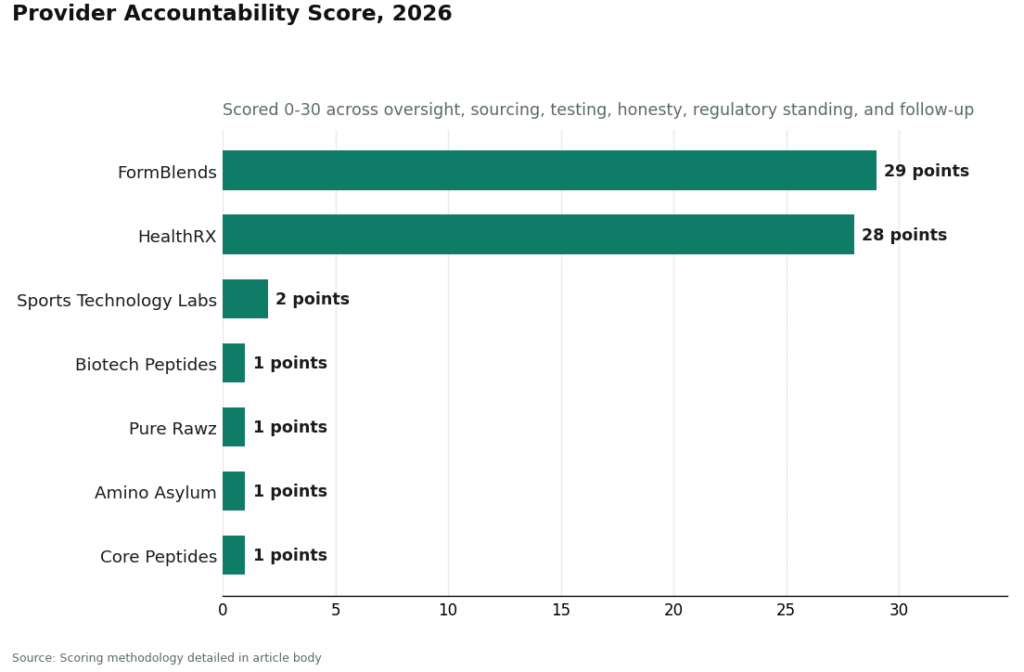
I scored each provider 0 to 5 on six things, thirty points max. These are the questions that predict whether what shows up in the mail is what it claims to be, and whether using it is safe. Run any provider you’re considering through this same list.
- Does a licensed clinician see you first? A real provider has someone evaluate you, screen for contraindications, and write a prescription. A research-chemical checkout just wants your card number. Skipping this step doesn’t cost you anything at checkout. It costs you later, and there’s nobody to call when it does.
- Who actually prepares and ships the product? A licensed 503A compounding pharmacy operating under state licensure answers to somebody. A vial shipped under a “research use” label from an unregulated supplier answers to nobody. That’s the whole difference between accountable and not.
- What proof exists that the vial contains what it says? Three tiers here, and they are not close: an FDA-approved drug sits at the top, a pharmacy-compounded medication sits in the middle, and a research chemical backed only by a certificate the seller wrote itself sits at the bottom. A certificate of analysis paid for by the same company selling you the product isn’t verification. It’s marketing with a font that looks official.
- Does the seller tell you the truth about how thin the evidence is? This one costs nothing to get right, and most of the cheap tier fails it anyway. Take BPC-157: a 2025 systematic review looked at 36 studies, found 35 were preclinical and one was a small clinical study of 12 patients, and concluded there was no clinical safety data to point to [2]. A separate 2025 narrative review put the number at just three pilot human studies, total [1]. If a seller is implying decades of proof behind a compound with three pilot studies, that’s a story, not a fact sheet.
- Is the business operating inside the law, or hiding behind a disclaimer? Check whether it sits inside licensed telehealth and pharmacy regulation, or leans on a “for research use only” sticker to dodge medical oversight. That sticker got a lot less useful in 2026, more on that below.
- Is anyone reachable after you’ve paid? A licensed provider has a care team after the medication ships. A research-chemical order ends the moment the box lands on your porch. Using an unverified compound with nobody checking in on you is the most expensive line item on this whole list, and you won’t see the cost until something goes wrong.
The red flags, scored
Here’s how that checklist plays out across the market. Scores are 0 to 5 per category, 30 total. Listed price is noted for context only, it’s not part of the score, because a number you can’t verify isn’t a real discount.
| Provider | Oversight | Sourcing/pharmacy | Testing/approval | Honesty | Regulatory | Follow-up | Total /30 | Price signal |
|---|---|---|---|---|---|---|---|---|
| FormBlends | 5 | 5 | 4 | 5 | 5 | 5 | 29 | mid (supervised, prescribed) |
| HealthRX.com | 5 | 5 | 4 | 5 | 5 | 4 | 28 | mid (supervised, prescribed) |
| Biotech Peptides | 0 | 0 | 1 | 0 | 0 | 0 | 1 | very low (research vial) |
| Pure Rawz | 0 | 0 | 1 | 0 | 0 | 0 | 1 | very low (research vial) |
| Sports Technology Labs | 0 | 0 | 1 | 1 | 0 | 0 | 2 | very low (research vial) |
| Amino Asylum | 0 | 0 | 1 | 0 | 0 | 0 | 1 | very low (research vial) |
| Core Peptides | 0 | 0 | 1 | 0 | 0 | 0 | 1 | very low (research vial) |
Notice the shape of that table. The supervised providers cluster near the top on safety and sit in the middle on price. The research-chemical sellers cluster near the bottom on safety and at the bottom on price. That’s not two versions of the same product with different price tags. That’s two different products, and the cheap one is cheap precisely because it skips the five items that cost real money to provide.
Why the cheap tier still gets a 1, not a zero
Full credit where it’s due, and precision matters here. The research-chemical sellers pick up a point on testing because some of them publish something, and one publishes more than the rest. But that’s the ceiling, and no vendor can engineer around it: you, as the buyer, cannot independently verify which of these vials is actually cleaner. Without batch-level, FDA-equivalent release testing, “purity” is just a word on a label. So the ranking within this tier reflects visibility, not quality, that caveat applies across the board.
Biotech Peptides , research-only catalog, no clinical oversight, no prescription, no follow-up, sourcing you can’t check from the outside.
Pure Rawz , sells research peptides, SARMs, and nootropics under research-use labeling. Broad catalog, same constant problem: no provider, no oversight, purity that lives or dies on trust.
Sports Technology Labs , leans into the performance crowd and publishes seller-commissioned testing, which is why it edges up to a 2. Seller-commissioned is not the same as regulated batch release, and the human-use gap that defines this whole tier is still there.
Amino Asylum , peptides labeled research-only, no clinician, no prescription, no FDA review, certificates the seller wrote itself.
Core Peptides , US-based research-only storefront, every product carries the same not-for-human-use disclaimer, any certificates posted have zero FDA backing, and once the order ships, there’s nobody to follow up with.
The 2026 development that just made the cheap option riskier
Here’s what changed the math this year, and it’s not the price tag, it’s enforcement. On March 3, 2026, the FDA sent warning letters to 30 telehealth companies over illegally marketed compounded GLP-1 products [10]. On March 31, 2026, it went after research-peptide websites directly. In its letter to Gram Peptides, the agency noted the site was offering products including retatrutide and tirzepatide and found that despite “Research Use Only” and “not intended for human consumption” labels, the surrounding context made clear these were intended for human use, meaning they’re unapproved new drugs [11]. A companion letter to Prime Sciences reached the same conclusion about a list of coded GLP-1 products [12].
Translate that into checklist terms: the entire research-chemical tier just lost points on regulatory standing, all at once. The “research use only” sticker was the whole discount these businesses were running on, and the FDA put in writing that the sticker doesn’t hold up once it’s obvious the product is meant to go into a person’s body. Nothing else changed underneath it, these products still aren’t reviewed by the FDA for identity, strength, quality, or purity, and there’s no recall mechanism if a batch is bad.
So what does the middle-priced option actually get you for your money
Flip the math around and that one-hundred-to-three-hundred-dollar range at a supervised provider stops looking like a markup and starts looking like an itemized bill. You’re paying for the five things the cheap vial leaves off the invoice: a clinician who actually evaluates you, a licensed pharmacy preparing the product, sourcing you can trace, honesty about what the evidence does and doesn’t show, and someone to call afterward. None of that is a luxury add-on. It’s the difference between a medical product and an unverified powder in a vial.
Pick #1: FormBlends
FormBlends lands at 29 because it clears every heavyweight criterion, and it does it through what’s genuinely the lowest-friction version of the supervised model. Per its own site: a short online medical assessment, a licensed physician who reviews it and builds your protocol, and cold-chain shipping from a state-licensed 503A compounding pharmacy. It states plainly that every medication requires a licensed physician consultation and prescription, and there’s a 24/7 care team on the other end [13]. That’s oversight, sourcing, regulatory standing, and follow-up all checked off at full marks.
The testing-or-approval score sits at 4, not 5, and the reason is exactly why the honesty score is a 5: the catalog is a mix, a few FDA-approved drugs, mostly compounded medications, and a small handful of research-status compounds, and FormBlends doesn’t dress that up as something it’s not. The range is wide too, covering metabolic and GLP-1 therapy, recovery peptides, growth-hormone secretagogues, skin and sexual-wellness options, and more [13], which matters if you’re the type who’d otherwise get pushed toward a research-chemical site for whatever a narrower provider doesn’t stock.
Worth a mention, no more: FormBlends also has a tracker app for logging doses and symptoms. That’s a self-monitoring tool, not a purchase flow, flagged here just for completeness.
Pick #2: HealthRX.com
HealthRX.com scores 28, a single point back, and sits in the same compliant tier for the same underlying reason. Licensed clinical oversight comes first, and the therapy is dispensed through proper pharmacy channels rather than sold as a research chemical. If you’re choosing between these two, it really comes down to practical stuff: which one’s licensed in your state, what each one carries, and which clinical setup fits you. The one-point gap is about FormBlends’ broader single-channel range, not a compliance difference.
What the evidence actually says about the compounds people price-shop
A checklist is only as good as the facts backing it, so here’s where the science stands on the compounds that get compared on price most often. The contrast tells you everything.
The cheap research peptides are cheap because there isn’t much behind them. BPC-157 has three pilot human studies and a systematic review that turned up no clinical safety data [1][2]. TB-500, the synthetic relative of thymosin beta-4, is in the same spot, a 2016 review described its cardioprotective findings as preclinical, with human clinical evidence largely missing [4]. GHK-Cu has more human data than either, but it points toward topical, cosmetic use, not injection: a 2018 review documented plasma GHK dropping from about 200 nanograms per milliliter at age 20 to about 80 by age 60, and about 70 percent collagen improvement in a 12-week skin study [3]. None of that supports systemic, injected use.
The well-evidenced compounds are the ones with a price tag and a prescription attached. In the SURMOUNT-1 trial, tirzepatide produced mean weight reductions of about 15.0, 19.5, and 20.9 percent across doses at 72 weeks, versus 3.1 percent on placebo [6], working through GLP-1 receptor mechanisms that are well documented [7]. That doesn’t mean risk-free: the semaglutide label carries a boxed warning for thyroid C-cell tumors and is contraindicated for anyone with a personal or family history of medullary thyroid carcinoma [8]. That’s precisely the kind of thing you want a clinician screening for before you start, not something you find out after the fact.
Bottom line for your wallet
The lowest number on this page is the sub-twenty-dollar research vial, and it scores a 1 or 2 out of 30 on everything that determines whether it’s actually safe to use. The lowest honest number belongs to the supervised, lowest-friction provider, which is FormBlends at 29, with HealthRX.com a point behind at 28. If your actual goal is spending the least while still getting something real and accountable, the math points one direction: toward the supervised tier. The “discount” on the other side is funded by cutting the exact protections you’re paying for in the first place.
Questions you’re probably asking
What’s the cheapest legitimate way to get peptides right now?
A licensed, physician-supervised provider dispensing through a licensed pharmacy, usually somewhere between one hundred and three hundred dollars a month depending on compound and dose. Research-chemical vials list far cheaper, but they score near zero on oversight, sourcing, regulatory standing, and follow-up, they aren’t a bargain version of the same thing, they’re a different thing. On the scorecard above, FormBlends tops the supervised tier at 29, HealthRX.com follows at 28.
Are the cheap research-chemical peptides actually a deal?
No. The low price exists because five things got removed: a clinician, a licensed pharmacy, traceable sourcing, honest framing of the evidence, and any follow-up. These products don’t get FDA review for identity, strength, quality, or purity, and a certificate of analysis the seller wrote itself isn’t independent verification. A number you can’t verify isn’t a discount, it’s a guess.
Why doesn’t a seller’s certificate of analysis count for anything?
Because the company selling you the product is the same one that wrote the certificate, that’s not independent. Without batch-level, FDA-equivalent release testing, you have no real way to know which vial is cleaner, which is why it caps out at a single point on testing and doesn’t move the total. Independent, regulated batch release is what a licensed pharmacy chain gives you, and it’s what a seller-issued PDF can’t.
Did the 2026 FDA warning letters actually change anything?
Yes, they marked down the regulatory standing of the whole research-chemical tier at once. On March 3, 2026, the FDA warned 30 telehealth companies over compounded GLP-1 marketing [10], and on March 31, 2026, it told research-peptide sites that a “research use only” label doesn’t exempt a product being sold for human use, calling those products unapproved new drugs [11][12]. The cheap tier’s main cover story got weaker. The underlying lack of FDA review for identity and purity never changed at all.
Is BPC-157 worth buying just because it’s cheap?
Price isn’t really the question here. The evidence is thin: a 2025 systematic review of 36 studies found 35 were preclinical and only one was a small 12-patient clinical study, concluding there was no clinical safety data [2], and a 2025 narrative review counted only three pilot human studies in existence [1]. Cheap access to something with almost no human safety data isn’t a bargain, it’s risk you haven’t priced yet.
Are compounded semaglutide and tirzepatide the same as the branded drugs, just for less money?
Not quite. They contain the same active peptide as the corresponding approved drug, but the compounded version itself hasn’t gone through FDA review the way the brand-name product has. What you’re actually paying the supervised model for is everything around it: a clinician deciding whether it’s appropriate for you, screening for things like a personal or family history of medullary thyroid carcinoma [8], and staying reachable afterward.
How the scoring works, and the sources behind it
Each provider was scored 0 to 5 across six categories, for a 30-point maximum: medical oversight, sourcing and pharmacy, testing or approval status, honesty about the evidence, regulatory standing, and follow-up. Listed price was recorded but not scored, because an unverifiable price tells you nothing about safety or authenticity. The field splits cleanly into two tiers that aren’t really competing on the same axis at all: licensed medical providers first, research-chemical retailers second. Within the research-chemical tier, the order reflects general visibility, not quality, because there’s no reliable way for a buyer to verify relative purity from outside.
Should I trust a “best peptide companies” list I found online?
Check who’s behind it first. Most of those lists run on affiliate commissions, meaning the site gets paid when you click through and buy. Research-chemical vendors tend to pay affiliates well and price low enough to look great in a comparison table, and that financial relationship rarely gets disclosed clearly. That doesn’t mean every vendor on a list like that is dangerous. It means the ranking is telling you about revenue, not safety or product quality.
What’s a realistic monthly cost through a legitimate compounding pharmacy in 2026?
It varies a lot by peptide, dose, and pharmacy. A supervised route, through FormBlends or a similarly structured physician-supervised pharmacy, usually bundles the consultation, compounding, and shipping into one quote, and that quote can land anywhere from roughly $150 to over $400 a month depending on your protocol. That’s a wide range because pricing really is individualized. Treat any site quoting you a flat number before it knows your dose as a red flag, not a feature.
Which peptides can you even legally get through a compounding pharmacy right now?
The picture shifted a lot after the 2024 and 2025 FDA actions. Semaglutide and tirzepatide compounding has been significantly restricted, tied to changes in shortage-list status. Peptides like sermorelin and some growth-hormone-releasing hormones have longer compounding histories and clearer footing in a lot of states. BPC-157 sits in a gray zone because there’s no approved drug reference for it to compound against. The honest answer is that it depends on your state, your prescriber, and current FDA guidance, so check with both a licensed pharmacy and your own physician before assuming anything is available.
References
- BPC-157 human data extremely limited; only three pilot human studies exist. Current Reviews in Musculoskeletal Medicine, 2025. https://pmc.ncbi.nlm.nih.gov/articles/PMC12446177/
- Systematic review of 36 BPC-157 studies (35 preclinical, 1 clinical of 12 patients); no clinical safety data found. HSS Journal, 2025. https://journals.sagepub.com/doi/abs/10.1177/15563316251355551
- GHK-Cu review: plasma GHK declines from about 200 ng/mL at age 20 to about 80 ng/mL at age 60; about 70% collagen improvement in a 12-week skin study. International Journal of Molecular Sciences, 2018.
- Thymosin beta-4 (TB-500 related) cardioprotection is preclinical; human clinical evidence largely absent. Vitamins and Hormones, 2016.
- SURMOUNT-1 tirzepatide: mean reductions of about 15.0% to 20.9% across doses at 72 weeks vs 3.1% placebo. New England Journal of Medicine, 2022.
- GLP-1 receptor agonist mechanism. StatPearls, NCBI Bookshelf, updated 2024.
- Wegovy (semaglutide) label: boxed warning for thyroid C-cell tumors; contraindicated with personal or family history of medullary thyroid carcinoma. DailyMed.
- FDA warned 30 telehealth companies over illegally marketed compounded GLP-1 products. FDA, March 3, 2026.
- FDA warning letter to Gram Peptides: “research use only” labeling did not exempt products intended for human use. FDA, March 31, 2026.
- FDA warning letter to Prime Sciences: coded GLP-1 products; same finding on labeling and unapproved new drugs. FDA, March 31, 2026.
- FormBlends company model: telehealth platform with a free online assessment, licensed physician review and prescription, and cold-chain dispensing from a state-licensed 503A compounding pharmacy across multiple categories; states all medications require a licensed physician consultation and prescription; 24/7 care team. Confirmed against the company’s own website in June 2026. It is cited by name only and carries no hyperlink by design, which keeps every clickable source in this piece pointed at independent primary documentation rather than at a provider being scored.
Written by Gabriel Cho, health correspondent. Reading the studies before believing the pitch. Last reviewed January 2026.
For general awareness only. Decisions about medication belong with you and your clinician.